

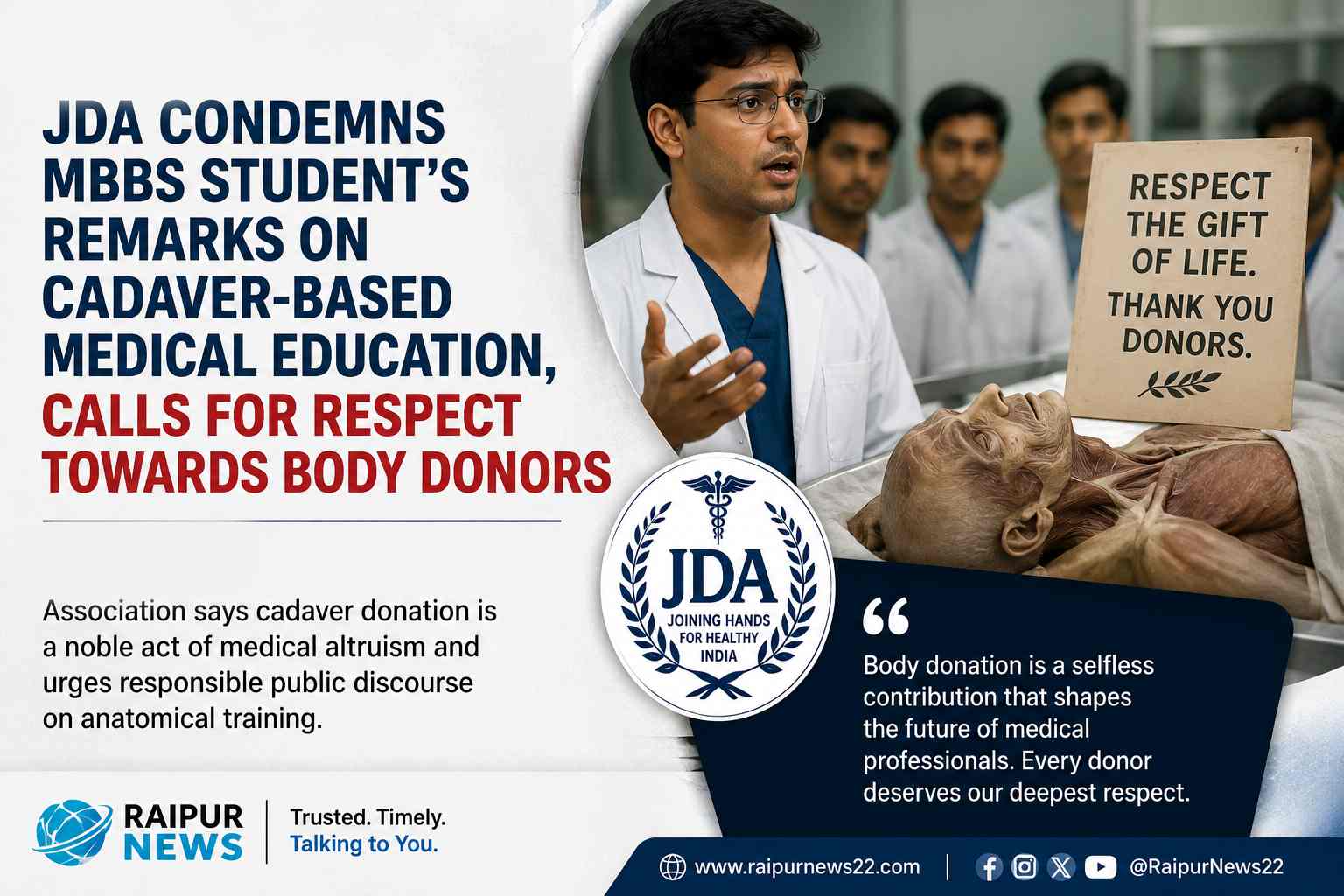
Association says cadaver donation is a noble act of medical altruism and urges responsible public discourse on anatomical training.
Raipur, 12 June, 2026: The Junior Doctors Association (JDA) has strongly condemned the reported remarks made by Sejal Pawar, an undergraduate MBBS student, regarding cadaver-based medical education, stating that such comments are inconsistent with the established principles, practices, and educational objectives of anatomical training in medical institutions.
In a statement, the association emphasized that the issue extends beyond mere disagreement and concerns the responsibility that accompanies public discourse, particularly on subjects that are central to medical education and public trust.
According to the JDA, a donated cadaver is not an object of ridicule, sensationalism, or obscenity. Cadaver donation represents one of the highest forms of medical altruism, where individuals voluntarily contribute to the advancement of medical science and education even after death.
The association highlighted that human body donation and cadaveric dissection have served as foundational pillars of medical education for centuries. Modern anatomy, surgery, and numerous advancements in medical science have been made possible through the contributions of body donors. Therefore, discussions concerning cadaver-based education should be conducted with accuracy, sensitivity, and utmost respect.
The JDA further noted that anatomy education and cadaveric study are universally recognized components of medical training. It argued that obscenity or malicious interpretation cannot be justified under the guise of freedom of expression guaranteed under Article 19(1)(a) of the Constitution when such expressions undermine the dignity associated with body donation and medical education.
Referring to the Supreme Court judgment in Permanand Katara vs Union of India (1995), the association stated that the right to dignity and fair treatment extends not only to living persons but also to their mortal remains. It stressed that dissection, preservation, teaching, research, and final disposal of donated bodies must be conducted respectfully, lawfully, and in accordance with donor consent and applicable regulations.
Drawing from Indian cultural traditions, the association cited the example of Sage Dadhichi, whose sacrifice is often regarded as a symbol of selfless donation for the greater good. It observed that Indic civilization has historically honored such acts of sacrifice and contribution to society.
The JDA also pointed to the continuing challenges surrounding body donation in India. While the National Organ and Tissue Transplant Organization (NOTTO) and state anatomy laws provide a regulatory framework for body donation, awareness remains limited. The association noted that only a small proportion of the population is adequately informed about body donation, and shortages of cadavers in medical education are primarily driven by awareness gaps, cultural hesitations, family resistance, and misconceptions regarding the treatment of donated bodies.
The association called upon medical students, healthcare professionals, and the public to uphold the dignity of body donors and to engage in informed, respectful, and constructive discussions on medical education and anatomical sciences.
Dr Amit Banjara
JDA Chhattisgarh








Leave a Reply